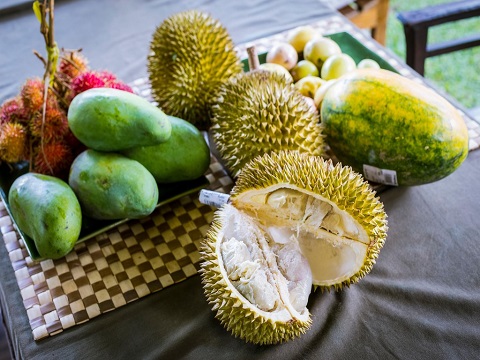
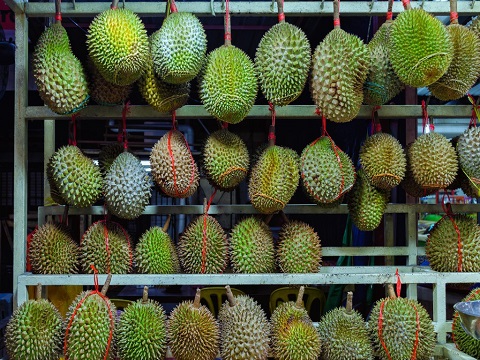
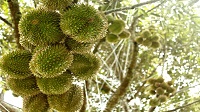
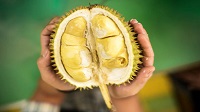
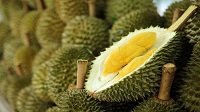
Durian is regarded by many people in Southeast Asia as “The King of Fruits”. The fruit is known for its thorn covering, large size, unique taste and distinctive aroma. The term Durian emerged from the fruits distinctive thorn covering and comes from the Malay word Duri which means thorn. The Durian is believed to have originated from the Malay Archipelago. Although the Durian tree is native to Malaysia, Brunei and Indonesia, it is also grown in Thailand, the Philippines and Australia.
Eating durian fruit can provide numerous health benefits although in depth knowledge on the full spectrum is still considered limited. Durian genome comprises about 46,000 genes, almost double that of humans who have 23,000 genes. Durian fruit is naturally rich in potassium, dietary fibre, iron, Vitamin C, and Vitamin B complex. It has also been found to have high anti-oxidant properties which are believed to provide anti-aging and cancer related benefits.
The Durian is the fruit of several tree species belonging to the genus Durio. There are 30 recognized Durio species, at least nine of which produce edible fruit. There are over 100 named varieties in Indonesia, 300 in Thailand and 100 in Malaysia. A Durian cultivar is essentially a specific variety of Durian that has been deliberately selected for desirable characteristics such as fruit shape, size, smell, colour, texture, taste and tree characteristics. Most cultivars have a common name and a code number starting with “D”.
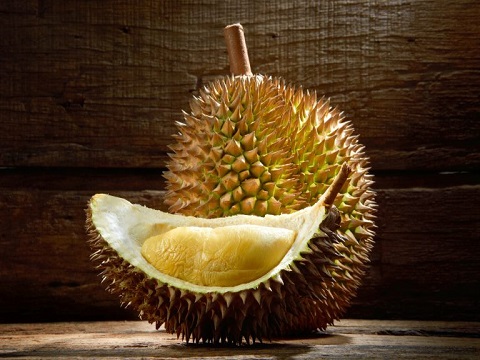
The taste of a durian is unforgetable. You will always remember the first time you taste one. You hate it or You Love it.
Durian is distinguished for its strong odor, large size, and thorn-covered husk. It can grow as large as 12 inches long and 6 inches in diameter, and typically weighs up two to seven pounds. Depending on the species, it can be round or oblong, its husk green to brown, and its flesh pale yellow to red.
Durian fruit is not noted for having a particularly appealing fragrance, but it its many beneficial attributes have earned it the “King of Tropical Fruit” title.
Durian is not only exquisitely delicious but richly nutritious, a complete natural meal in itself high in carbohydrate, proteins, fat, minerals, and vitamins. The exact nutritional composition of a ripe durian can vary greatly, depending on soil richness, growing methods, climate conditions, and variety.
I decided to put together tours to highlight my favorite durian-growing regions, farmers, and of course durians.
Over 700 durian farms around the world. Keep up to date when durian farms, durian farmstays, durian stalls, and other durian points of interest that actually have durian NOW, and also includes 3-month predictions so you can plan your trip.
It has been growing enormously with new Durian based products continuously being developed. Major global companies have all released Durian based products in effort to capture this growing market. Raw Durian Fruit, Desserts, Snacks and Beverages.
To choose a durian, pick a fruit which is comparatively light and whose stem appears big and solid. When shaking a good durian, the seed should move. Maturity is indicated when the middle of the fruit exudes a strong, but not sour smell. Finally, an inserted knife should come out sticky this is the best indication that the fruit is ripe.